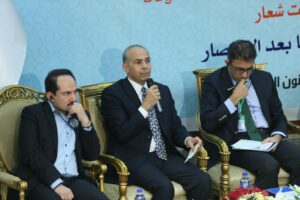

On April 15, 2017, the above conference was held in the National Council Hall under the patronage of a member of the Presidency of the Council of Representatives, and under the slogan:
“Education After Victory… Building the Human Being and the State.”
The first session was titled “Educational Curricula and National Identity.” Below are the main highlights.
First Session
The session was attended by representatives of the relevant bodies, as follows:
- Ministry of Education – Curriculum Directorate
Dr. Hassan Mohammed Smayan (Deputy Director General)
Paper: “National Identity in School Curricula – Islamic Education as a Model.” - Ministry of Education – Curriculum Directorate (Educational Philosophy)
Dr. Hussein Salem Makawon
Paper: “Educational Philosophy, Its Objectives, and Its Curricula.” - College of Education, Ibn Rushd
Prof. Dr. Alawi Sader Jaza’ (Dean)
Paper: “Educational Curricula, National Identity, and the Challenges of Iraqi Reality – Primary Education as a Model.” - Asst. Prof. Juman Kubba (Professor and Researcher in Neuroscience) – United States
Scientific paper: “Children of War and What the Future Holds: The Time Bomb.” - Iraqi Media Network
Dr. Naji Al-Fatlawi
Paper: “Primary Education in Iraq.” - Research Department of the Council of Representatives
Mr. Firas Jasim
Comparative study: “School Curricula and a Society of Diversity.”
Note: All research papers are available in full.
Interventions After the Presentations
Mohammed Tamim
Former Minister of Education and Member of Parliament
- The Ministry of Education launched an integrated educational philosophy project after 2008.
- In 2012, science and mathematics curricula were reviewed by an independent international body, UNESCO, which evaluates regional curricula. Iraq ranked first in the Middle East in 2013, followed by Iran, then Kuwait and Jordan.
- Comprehensive teacher training is essential. By 2014, nearly 180,000 teachers were trained, representing 45% of total teaching staff.
- No funds were allocated in the 2015, 2016, and 2017 budgets for teacher training.
- The best educational institution in the Middle East is the Qatar Foundation, staffed mainly by Europeans and Americans. The only Arab presence there is from Iraq—graduates of gifted schools that produced more than 200 Iraqi scientists.
- In 2003, Iraq had fewer than 9,000 school buildings; today there are 14,000, meaning 40% were added in 13 years.
- Budget allocations to education:
2004: 0.8%
2005: 0.7%
2006: 0.2%
2008: 1%
2009: 1.4%
2010: 2.1%
2011: 1.5%
2012: 1.2%
2013: 1.5%
2015: 0.2%
2016: 0.1%
Current year: almost nothing (about two per billion of the budget). - Schools completed annually:
2005: 12
2006: 201
2007: 487
2008: 529
2009: 509
2010: 286
2011: 350
2012: 564
2013: 550
2014: 432
2015: 157
2016: 24 - The General Authority for Buildings decides whether school buildings are fit for use and whether they should be demolished.
Ibrahim Al-Baghdadi – Head of the Economic Committee
- Curriculum committees must be carefully selected and independent.
- Establish a specialized educational TV channel for primary education.
- Apply quality systems and train teachers, with incentives for teachers and students.
- Working with session organizers to build the first school under the “Wafa’ Iraq” initiative.
Dr. Tahseen Al-Hassnawi
- Citizenship must be discussed in curricula.
- Empower girls in education.
- Focus on the teacher’s role in shaping the child’s brain and personality.
Laith Al-Haidari
- Replace the concept of conflict with cooperation in schools.
- Media should shift from distraction to focus; art and drawing should reinforce Iraqi identity.
- Launched the Imam Hassan Project in Najaf schools.
Prof. Dr. Khaled Fahd Al-Jubouri
Dean, College of Education – University of Baghdad
- Western countries are preparing for post-internet education, while Iraq still relies on printed notes.
- Invite colleges of education to develop teachers.
- In Germany, churches were turned into schools after WWII. Iraq has 72,000 mosques and husseiniyas and only 14,000 schools—why not use them?
- Convert curricula to online platforms and increase teachers’ salaries instead of spending on printing.
Prof. Dr. Karim Hussein Nasser (Retired)
- Remove the Ministries of Education and Higher Education from political quota systems.
- Educational philosophy must be practical.
- In basic education, values should be taken without sectarian labeling.
- Emphasize Arab identity.
Representative of Imam Ali School
- Curricula arrive late to students.
- Private education percentages: Japan 65%, Lebanon 85%, USA 55%. Supporting this sector reduces the burden on the state.
Bashar Al-Saleh – Teacher
- Replace Islamic Studies with a general Religion subject.
- Add a Humanity subject similar to life-skills education.
Fadhil Al-Aboudi – Educational Supervisor
- Reduce the number of books carried by primary students.
Asst. Prof. Ahmed Abdul Hussein Al-Fartousi – Ibn Rushd College
- Are scientific curricula keeping pace with global developments?
- A law to protect teachers is needed.