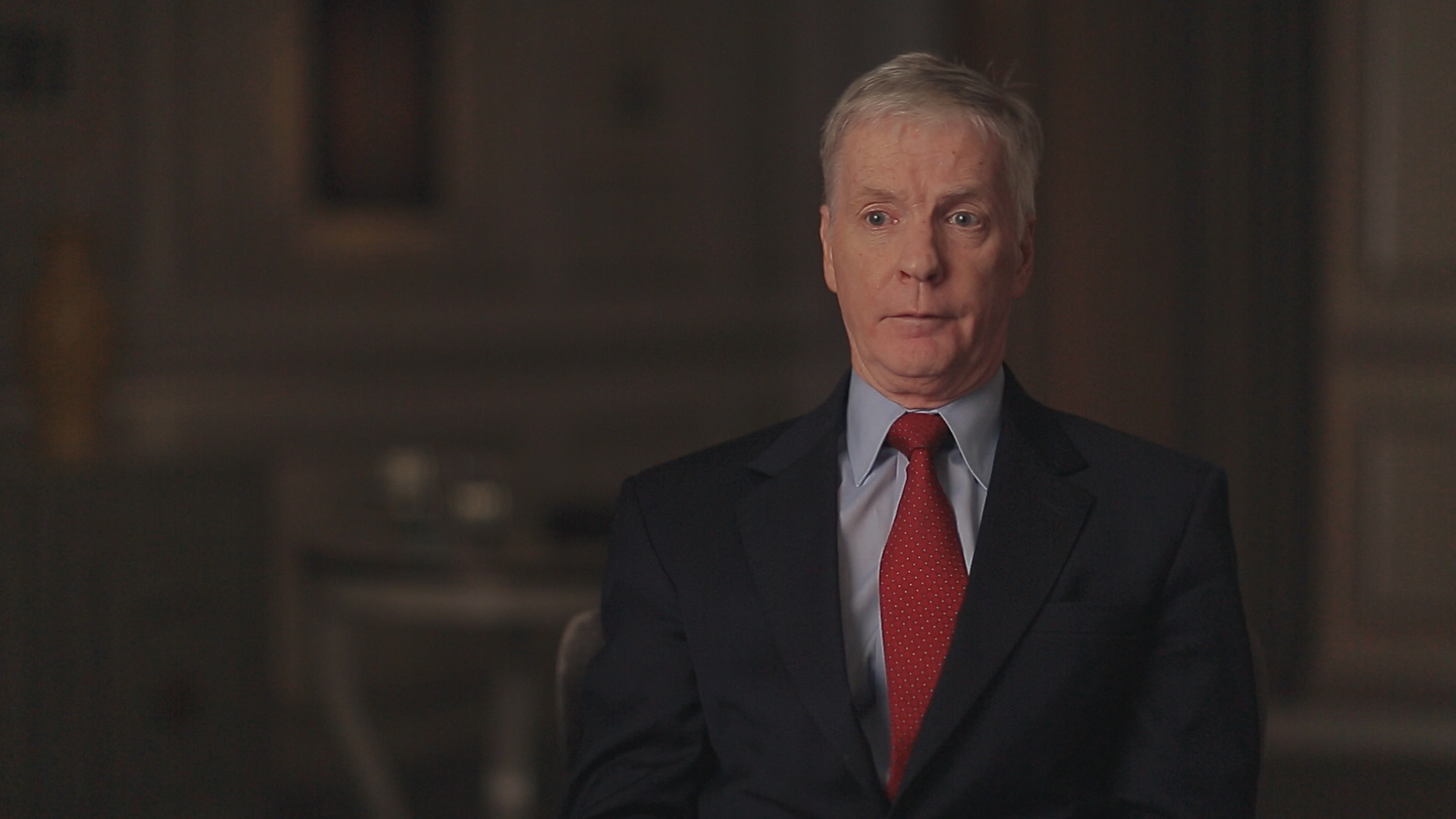
Following his participation in the fifth edition of the Baghdad International Dialogue Conference, organized by the Iraqi Institute for Dialogue on March 19, 2023, former U.S. Ambassador to Iraq Ryan Crocker wrote his reflections on Baghdad.
Below is the full text of the article written by the American diplomat Ryan Crocker:
Over the weekend, Ryan Crocker took a car ride to a Syrian restaurant in Baghdad. This simple activity offers a glimpse into the profound changes the Middle East has undergone since his service as U.S. Ambassador to Iraq between 2007 and 2009. After two decades of devastating violence following the U.S.-led invasion that ended a quarter-century of authoritarian rule under Saddam Hussein in 2003, Iraq’s capital has experienced relative calm over the past several months.
“There is life in this city again,” Crocker says. “It’s dusty and uninteresting—as it always was—but it’s alive. You can feel the energy.”
At the same time, the restaurant’s owners were among the seven million refugees who, according to United Nations estimates, fled Syria after the outbreak of the civil war in 2011 and after the Islamic State exploited instability and sectarian conflict—fueled by the U.S. intervention—to seize large swaths of Iraq and Syria.
Crocker was in Baghdad to attend a conference coinciding with the twentieth anniversary of the U.S. invasion of Iraq, which unleashed a chain of events that reshaped the region, for better or worse. In an interview with this newspaper, Ryan Crocker—originally from Spokane Valley, Washington, who returned to his hometown after four decades in the Foreign Service during which he was awarded the Presidential Medal of Freedom—shared his reflections on the lessons of the Iraq War and what the future may hold for the country.
“There is a widespread assumption among critics of the war that if the United States had not invaded Iraq, everything would have been fine,” Crocker says. “That is not true.”
After serving as U.S. Ambassador to Lebanon, Kuwait, and Syria, Crocker returned to the U.S. State Department to serve as Assistant Secretary of State for Near Eastern Affairs just weeks before the September 11 attacks. In March 2003, Crocker was in Ankara, where he unsuccessfully attempted to persuade the Turkish government to allow U.S. forces to land at Turkish ports—an action that would have enabled a two-pronged military advance on Baghdad, effectively placing the capital in a pincer movement.
As Crocker was preparing to return to Washington, he watched President George W. Bush announce the start of the invasion on television.
“I knew clearly that the military operation would be constrained by the absence of a northern front. There would be no pincer closing in on the capital.”
Before U.S. and coalition forces reached Baghdad, Iraqi soldiers burned their uniforms, hid their weapons, and disappeared into the countryside.
The United States compounded the problem by dissolving the Iraqi army after taking control of the capital and establishing a provisional government, setting the stage for the insurgency that would fight U.S. and allied forces for years.
From the invasion until August 2021, violence claimed the lives of approximately 4,600 U.S. soldiers, more than 3,600 contractors and civilian Defense Department employees, over 45,000 Iraqi soldiers and police officers, and around 200,000 Iraqi civilians, according to data from Brown University’s Costs of War Project. Including veterans’ care, the wars launched by the United States in the aftermath of September 11 cost approximately $8 trillion, the project estimates.
Former President Barack Obama, who campaigned on a promise to withdraw U.S. forces from Iraq, ended combat operations in the country in 2010. Today, about 2,500 U.S. troops remain in Iraq in a limited role focused on training and advising Iraqi forces. A small number of U.S. special forces continue to operate in the country, though the Pentagon does not disclose their numbers.
The U.S. Senate is expected to pass a resolution this week repealing the authorization Congress granted in 2003, a move that is largely symbolic and unlikely to affect ongoing military operations in Iraq, according to Crocker. When Iraqi officials are asked about Congress’s decision to revoke the authorization, they appear largely indifferent.
“Around the world, the question is: what is the authorization for the use of force?” Crocker says. “This repeal will not affect the portion of our forces deployed here. As for the small number of special forces, I have been informed that it will not affect how they operate.”
The conference in Baghdad was sponsored by Iraq’s new Prime Minister, Mohammed Shia’ Al-Sudani, who has been in office since last October. While critics have warned that Al-Sudani is closely aligned with Iran, Crocker says the conference showed positive signs regarding the path the new Iraqi leader appears to be taking.
Unlike previous prime ministers who spent years in exile, Al-Sudani has spent nearly his entire life in Iraq. Crocker notes that this may help him combat the pervasive corruption that hampers Iraq’s development, adding that corruption “is not their fault.”
“When a foreign army intervenes, removes a government and its institutions, and enables another form of governance, you end up with people ruling without institutions and with a broad absence—and acceptance—of the rule of law,” Crocker adds. “In such an environment, you can put money in dark rooms for twenty-four hours, and the result will be corruption of extraordinary magnitude.”
Crocker, who later served as U.S. Ambassador to Afghanistan from 2011 to 2012, says that while Iraq is fundamentally different from the Central Asian country invaded by the United States in 2001, both nations were similarly afflicted by corruption.
“Ultimately, these countries and those who govern them are the only ones capable of reforming themselves,” Crocker says. “That is one of the many things that cannot be fixed from the outside.”
Attending the conference—which Crocker says included academics and investors from the United States, but no representatives from Russia or Iran—reassured him about Iraqis’ ability to develop and preserve their democracy. One promising development, he notes, is that militia leaders whose forces prolonged the war have now chosen to lay down their arms and transition into politics, exercising influence through state institutions rather than violence.
Reflecting on the two decades since the war began, Crocker says he still does not know whether the invasion of Iraq was the right decision. The Bush administration justified the invasion by claiming Saddam Hussein possessed stockpiles of weapons of mass destruction—a claim later found by a 2004 U.S. Senate report to be based on faulty intelligence—but Crocker says the true rationale for the war was more complex.
“I opposed the invasion because I knew we would get stuck there, and I had no idea what we would do, nor did I have any better plans,” Crocker said.
After coming to power in 1979, Saddam invaded Iran, launching a bloody war that lasted until 1988. Shortly thereafter, he invaded Kuwait in 1990, triggering the Gulf War and the imposition of international sanctions on Iraq. By 2002, the sanctions regime was collapsing, and Saddam was “starting to break out of the cage.”
“That is why I find the entire episode deeply painful,” Crocker says. “I had nothing to add. I could not say, ‘Let’s do something else that would reduce the threat posed by Saddam without going to a war that would last twenty years.’”
While he does not consider himself an optimist, Crocker says he is encouraged by what he has seen in Iraq and the region, including the Abraham Accords and the restoration of diplomatic relations between Israel and three Arab states. However, he adds, the Iraq War should teach the United States an important lesson.
“Be careful what you get yourself into,” Crocker says. “Launching a massive military operation to overthrow a government and occupy a country is an event of almost unimaginable scale, and its repercussions will last for years.”