In the Name of God, the Most Gracious, the Most Merciful
Your Excellencies, Eminences, Honorable Guests,
Peace, mercy, and blessings of God be upon you.
I warmly welcome you to the House of the People, your second home, and extend my greetings to our honored guests in their second country, Iraq, wishing them a pleasant stay.
I also congratulate you, our heroic people, and the peoples of the region on the great victories over ISIS, achieved by the brave sons of Iraq—our military and security forces, the Popular Mobilization Forces, the Peshmerga, and the tribal fighters—along with all those who supported and assisted them.
Our contemporary history has recorded great stories of national unity—rare in their depth—embodying the nobility and courage of our people in defending their oppressed brothers who suffered under ISIS, its brutality, enslavement of women, and violations of all human and moral values. Our people have offered thousands of martyrs and wounded, writing the greatest epics of heroism to protect honor, liberate the land, and preserve national sovereignty.
Brothers and sisters, ladies and gentlemen,
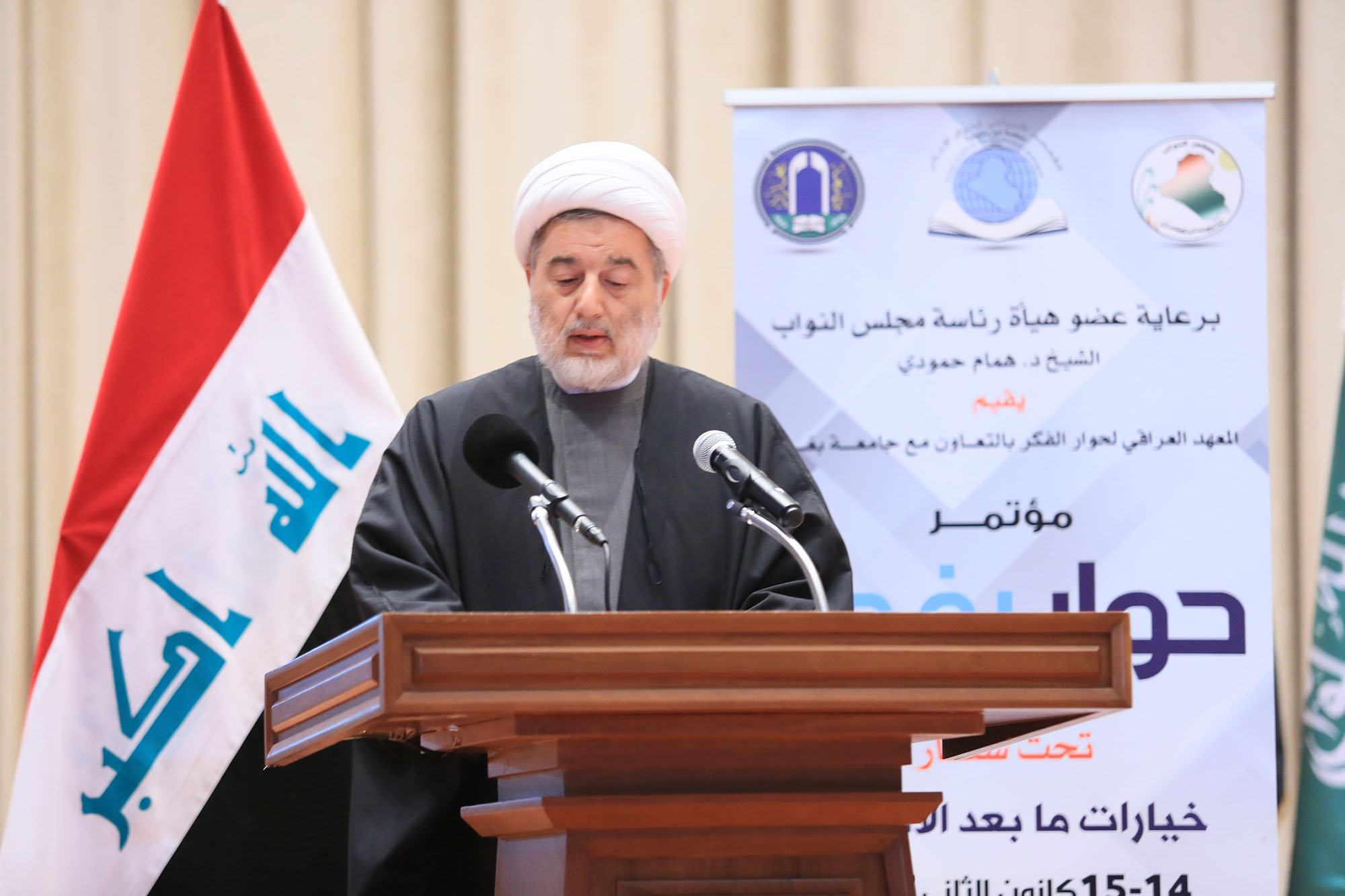
We welcome you to our conference, which is titled “Dialogue”, the approach we believe is the most appropriate and righteous for understanding one another, reading reality with insight and sincerity, drawing inspiration for solutions, creating opportunities, and overcoming challenges—regardless of differing views.
We chose “Baghdad”—the City of Peace—as the name of this dialogue, to remind the world of Iraq’s and its capital’s historic and civilizational role: a center that attracts, influences, embraces, and creatively contributes to humanity.
The theme of our conference is “Options After Victory”, based on our belief that the perspective of the victor is more accurate, realistic, and objective than that of the defeated, which is often shaped by despair. This is reflected in the Qur’anic verse: “So glorify the praise of your Lord and seek His forgiveness.”
The Iraqi people were among the first to defeat ISIS. This victory was not easy; it came under extremely difficult circumstances—political crises, popular reform movements, fragile internal security, a severe financial crisis due to falling oil prices, and the burden of millions of displaced people. Yet our forces, in all their branches, regained the initiative. The historic fatwa of the supreme religious authority in Najaf played a pivotal role in inspiring the people with a spirit of self-sacrifice. A new chapter of steadfastness began, from the resilience of Amerli to the successive liberation of cities. We fought the battle for existence and the battle for reform at the same time.
We extend our gratitude to all who stood by Iraq and supported it in this struggle, while affirming that the liberation of our land was achieved by Iraqi hands and national will.
These victories have earned global admiration and ushered in a new era for Iraq—one of courage, insight, discernment of friends and foes, innovation, cooperation, trust, unity, solidarity, and cohesion.
The battle against ISIS revived Iraqi national spirit and strengthened bonds of trust and understanding. This is a vital step toward re-examining our situation and building a future vision for Iraq after ISIS.
The liberation of Nineveh and the fall of ISIS represent a source of pride for all Iraqis, as they are the fruit of national unity and will remain a bright page in Iraq’s history.
Our problems can only be solved by ourselves. “Indeed, God does not change the condition of a people until they change what is in themselves.” Our challenges are clear after years of experience with extremism. We have organized them into four main axes for this conference:
First: Security
The foundation of the state, its authority, stability, and development. After defeating ISIS militarily, we must define a new vision to overcome this challenge.
Second: State-Building
Based on citizenship and the rule of law, with participation from all. Various options are debated, including cross-sectarian political blocs, majority governance, decentralization, or recentralization.
Third: Post-Victory Responsibilities
Caring for martyrs’ families, treating the wounded, returning displaced persons, and addressing the social consequences of war, corruption, and the transition from dictatorship to democracy.
Fourth: The Region
Strengthening Iraq’s role regionally and internationally, protecting its internal front from interference, and contributing to regional stability.
We hope this forum will witness honest, bold, and transparent dialogue that addresses challenges while recognizing achievements.
We express our gratitude to the Iraqi Institute for Dialogue of Thought, the University of Baghdad, the Council of Ministers, the Council of Representatives, universities, ministries, media organizations, civil society, and all who supported this conference.
In conclusion, we apologize for any shortcomings, and we thank all participants for honoring us with their presence.
Peace be upon you and God’s mercy and blessings.
I now invite His Excellency President Dr. Fuad Masum to deliver his speech.