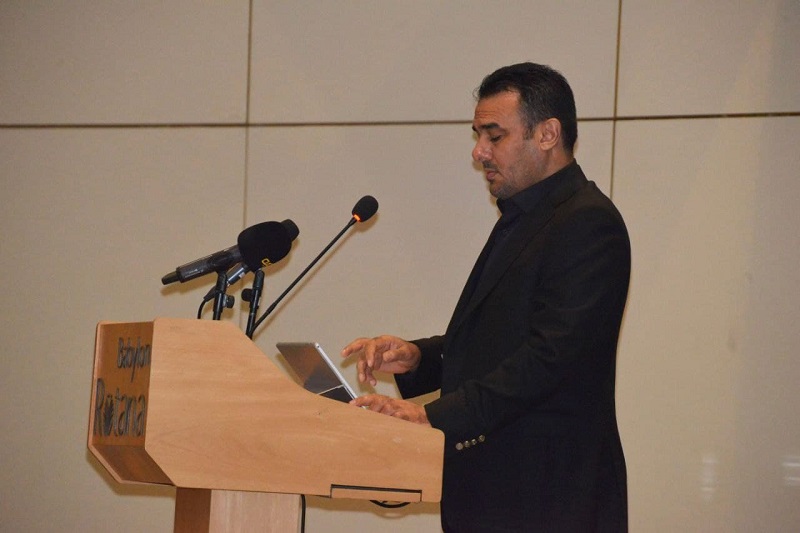

Delivered by Mr. Abbas Radi Al-Ameri, Director of the Iraqi Institute for Dialogue and Executive Director of the Baghdad Dialogue Conference
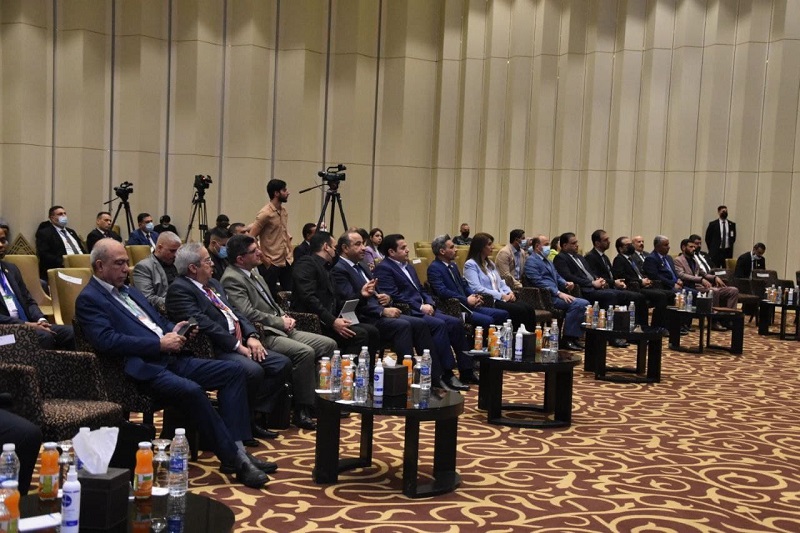
The activities of the Fourth Baghdad International Dialogue Conference were launched with an opening speech delivered by Mr. Abbas Radi Al-Ameri, Director of the Iraqi Institute for Dialogue and Executive Director of the Baghdad Dialogue Conference.
How Can Iraq Transform into a Regional and International Actor?
It is deeply saddening to mourn a loved one—yet such is destiny.
To describe your country, your homeland, your earthly paradise, as a “fragile,” “weak,” or “failed” state is extremely painful… yet, my friends, this is the reality. There are international standards that states aspiring to escape the darkness of fragility, weakness, and failure cannot fall short of. Unfortunately, Iraq has entered various degrees of this weakness in different and uneven ways, yet it has continued— as a state— to be described as such to a significant extent.
Regional policies and the logic of interaction among key regional powers have turned Iraq into an arena for competing influence, making it difficult for Iraq to overcome the contradictions of values among neighboring states, and equally difficult for it to serve as a space for settlement amid the intensification of zero-sum equations governing the intentions of those neighbors.
What matters here is not lamenting the past or mourning misfortune. As an elite, we have become capable of influencing inputs. In fact, the Iraqi elite today enjoys a historic opportunity to transform Iraq into an effective state, both domestically and externally—one that is harmonized with and interactive within its international environment. This requires the elite to adopt a logic of utilizing or even creating opportunities within a turbulent environment, and to think in ways that free Iraq from entrenched patterns imposed by the nature of political inputs following 2003, moving instead toward new inputs based on enhancing Iraq’s image as a country of importance that has overcome the challenges threatening its existence and continuity.
For over a year, the Iraqi Institute for Dialogue has been working on drafting a comprehensive strategy for transforming Iraq into an effective state and breaking free from the trap of failure, weakness, and fragility— a condition shaped by external policies that have long invested time, money, and effort to sustain it since Iraq’s independence and the establishment of the Iraqi monarchy until today.
The contradiction of interests, a defining feature of Iraq’s regional environment, seeks to perpetuate the fragility of the Iraqi state in order to provide greater opportunities for neighboring states to advance their interests and sustain their value-based conflicts, which fundamentally shape their political existence. Iraq’s transformation into an effective state would significantly affect the continuity of these ruling political systems, as Iraq historically has not achieved the sustained stability seen in other regional states. This can largely be explained by the linkage between the survival of these systems and the fragility of Iraq, and the weakening of its effective regional role.
Declassified documents in the United States have revealed that 14 Arab, regional, and international intelligence agencies have worked to prevent Iraq from becoming a stable economic market or a positive security environment, based on what those countries consider to be their national interests. At the core of regional strategies lies the extent to which these states can attract opportunities away from Iraq. For Iraq’s transformation into an economically or security-attractive state would deprive them of competitive advantages derived from Iraq’s fragility.
The Curse of Oil and Maritime Geography
Iraq possesses significant advantages that make it a focal point for countries with major security strategies, foremost among them the great powers. However, the most painful actors for Iraq are those with whom its people share blood, religion, language, brotherhood, and destiny. The intelligence services of these states have persistently sought to undermine every positive step taken by Iraq so that it does not become an international port, a global oil market hub, or a vital link in the Silk Road—particularly through its maritime outlet and dry canal connecting it to Europe.
Iraq’s importance lies in its geopolitical features that attract the attention of major powers. Yet the regional balance of power is based on the assumption that any effective Iraqi role diminishes the competitive advantages of its neighbors. This drives them to pursue strategic projects that create alternative advantages for themselves while stripping Iraq of the ability to leverage its own capabilities, thereby perpetuating Iraq’s fragility and inability to exploit its geopolitical strengths.
What Is a Failed State?
A state becomes failed when it loses authority and effective control over its territory, and when it is unable to exercise its legitimate monopoly over the use of force. It becomes fragile and weak when it loses legitimacy in decision-making and implementation, fails to provide reasonable public services, or is unable to interact with other states as an effective member of the international community.
In a 2014 report by Foreign Policy magazine in cooperation with the Fund for Peace, Iraq ranked 13th among the world’s most fragile states, based on 12 key indicators. Political indicators included the loss of state legitimacy due to elite corruption, lack of transparency and accountability, erosion of trust in official institutions, weak rule of law, widespread human rights violations, insecurity, and the risk of civil war.
Economic indicators included the absence of sustainable development among diverse social groups, declining national income, trade balance deterioration, and currency instability. Social indicators focused on rising demographic pressures, irregular population movements, refugee flows, and displacement.
Reconfiguring the political, economic, and social inputs governing state performance is a critical criterion for Iraq’s transition from a fragile to an effective state, alongside reassessing opportunities that can be utilized or created within regional and international environments. Iraq’s inherent advantages qualify it for this role, provided that experts and the Iraqi elite adopt this objective as a guiding path for decision-makers.
The Fourth Baghdad International Dialogue Conference serves as a forum for political elites who believe that Iraq’s effectiveness lies in utilizing its resources and reassessing interaction dynamics within its regional environment. Strategic calculations—both scientifically and practically—affirm that Iraq is a state of significant strategic weight that cannot be marginalized at any level of external engagement. However, leveraging opportunities requires carefully considered choices characterized by wisdom, realism, and a sound understanding of interactions and interests within regional and international environments.